
Find resources right for you.


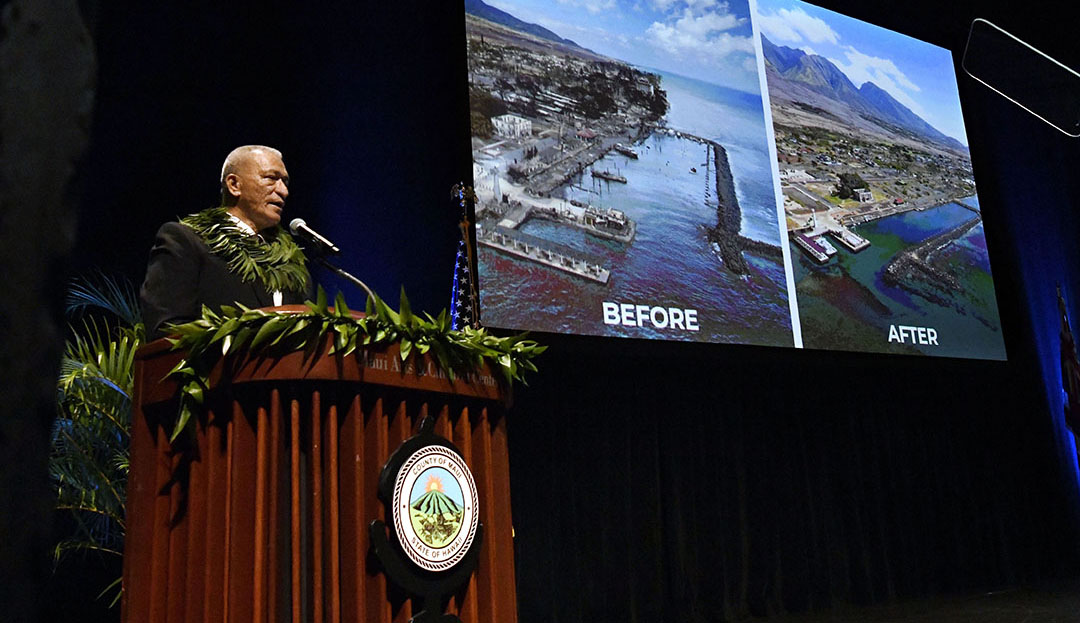
Comparing the resiliency and strength of Maui Nui’s people to the koa tree, Mayor Richard Bissen vowed to remain rooted in his kamaʻāina housing priorities by continuing to deliver on homes, water and infrastructure during some of the most challenging times in recent history.
“We are not finished – we are committed to seeing this work through,” Mayor Bissen said during the annual State of the County Address. “My number one priority is to keep our people home. If you are thinking about moving away from Maui County — don’t. Change is not coming. Change is here.”
Mayor Bissen said that affordable and workforce housing under his administration has increased 190% from previous years, and nearly 3,000 affordable and workforce homes will be built by 2030.
Also, the mayor is making an unprecedented shift toward public stewardship of water management. He announced that the County is in negotiations with several companies to acquire key water system assets in West Maui. Once completed, public stewardship of drinking water systems will increase from 45% to 93%, representing a major step toward restoring balance.
Mayor Bissen spoke before hundreds of residents and community leaders in his fourth State of the County Address from 5 to 7 tonight at Maui Arts & Cultural Center’s Castle Theater in Kahului. He highlighted significant progress across housing delivery, wildfire recovery, infrastructure investment, community well-being, environmental stewardship and economic diversification — marking a key move from disaster response to long-term resilience and readiness.
Housing increases under Bissen administration
According to real property data, for nearly a decade, affordable housing delivery averaged fewer than 100 homes a year. Since 2023, the County of Maui has seen an average of 293 affordable homes per year — a 190% increase in affordable housing delivery.
The County is expecting to produce an average of 414 affordable homes per year over the next five years. In all, the mayor projected nearly 3,000 affordable and workforce homes will be built by 2030.
To achieve that, Mayor Bissen is committing to investing more than $1.29 billion in housing-related infrastructure, and another quarter-billion dollars in County investments directly toward affordable and workforce housing.
Including recovery-related and market housing construction, the County is on track to deliver more than 5,000 homes and apartments over the next five years, averaging more than 1,000 homes annually.
“Through the collective work of the County, the State, House Maui, private and nonprofit developers, and our community partners, we are generating real, sustained momentum to confront our housing crisis and deliver homes that keep local families in Maui Nui,” Mayor Bissen said.
Alongside developing new water sources countywide, Mayor Bissen said the County is strengthening public stewardship of water systems in West Maui.
Mayor Bissen announced that the County is in negotiations with Kamehameha Schools, Maui Land & Pineapple Company and West Maui Land to acquire key water system assets, including the Olowalu and Launiupoko irrigation and water companies, the Honokōhau Ditch System, and multiple wells and related infrastructure. Once complete, water systems in West Maui, including both drinking and irrigation, will transition from 25% to 65% publicly-owned.
“More importantly, public stewardship of drinking water systems will increase from 45% to 93%, representing a major step toward restoring balance and ensuring this essential resource is managed in the public trust,” Mayor Bissen said. “This work will continue as I believe water stewardship belongs in the hands of our people.”
The County of Maui plans to invest more than $1.29 billion over the next five years in major infrastructure projects to support housing growth across the island. Investments will focus on water, wastewater, transportation and drainage systems needed to expand long-term housing capacity.
Key projects include:
Mayor Bissen is advancing a kamaʻāina-centered economy focused on creating living-wage jobs, supporting local businesses and building long-term economic resilience.
“A strong economy is one that works for the people who live here — creating living-wage jobs, supporting local businesses and giving our youth a reason to build their future here,” he said.
Highlights include:
To view a recording of the 2026 State of the County Address, visit the County of Maui Facebook page (no account needed to view).
For a copy of the full speech, presentation and to learn more about housing delivery, wildfire recovery, infrastructure investment, community well-being, environmental stewardship and economic diversification, visit https://www.mauicounty.gov/2954/2026-State-of-the-County-Address.
